
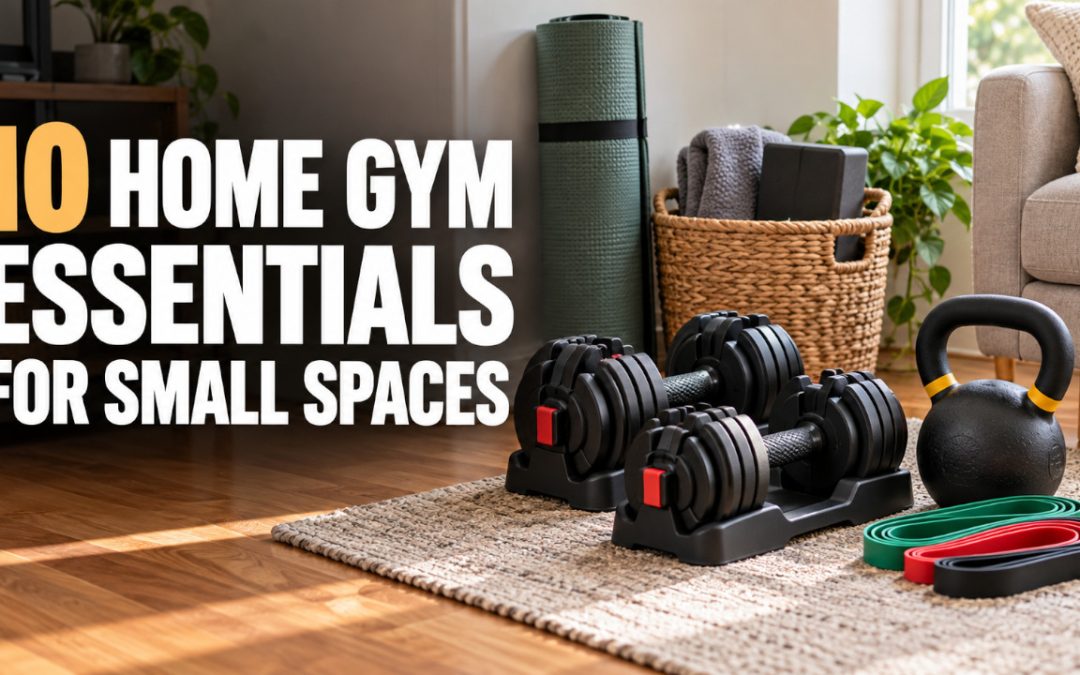
If your workout space is also your living room or bedroom, storage space matters almost as much as the equipment itself. Before actually buying anything, ask where it will go when you are not using it. Look for equipment that suits your workouts and is easy to put away. Check how much room it needs during exercise, too. A machine that folds neatly into a corner can still be too large once you open it. This is a problem that I myself have struggled with. So to solve it, I have compiled ten great options for home gym essentials. Options that will be useful for beginners and lifelong workout addicts.
Before you buy home gym essentials
Measure where you will exercise and where the equipment will live afterwards. They are rarely the same space. In your workout area, allow room for your body and the equipment throughout each movement. Check overhead clearance for standing exercises and leave doors, walkways and exits unobstructed. For machines, follow the manufacturer’s instructions. As for storage, measure the actual opening beneath a bed or inside a cupboard, including anything that could get in the way.
Consider the weight of equipment you will need to move regularly. A compact bench is less convenient if carrying it out makes every workout a chore. If you live upstairs, think about noise as well as size. Controlled movements and carefully setting weights down are more considerate than jumping or dropping equipment. A mat may cushion contact with the floor, but it will not make an upstairs workout soundproof. I know this may all sound quite basic, but you’d be surprised how many people overlook these initial steps before purchasing their home gym essentials.
Disclosure: This article contains paid affiliate links. As an Amazon Associate I earn from qualifying purchases.
1: A roll up exercise mat
An exercise mat gives you a comfortable surface for floor-based movements such as bridges, stretching and kneeling exercises. It is an easy starting point if your current setup is simply a patch of hard floor. A roll-up mat can stand in a cupboard or slide into a storage bag. Before buying, check its length and width against your height and available floor area, along with the size of the rolled mat. Thickness involves a trade-off. Extra cushioning can feel more comfortable when kneeling, while a very soft surface can feel less stable during standing movements. Grip, ease of cleaning and compatibility with your floor matter too. Choose a mat designed for the activity you plan to do. A soft exercise mat is not automatically suitable as the base for a heavy bench or cardio machine.
2: A set of long loop resistance bands
Long loop bands offer several resistance levels in a small storage bag. Depending on the band and your setup, they can be used for movements such as rows, presses and assisted exercises. The whole set can go into a drawer afterwards. Choose a range with a light enough band for your starting exercises; buying only the strongest one limits what you can do with it. Check the material, length and intended uses. Resistance labels are not standardised across brands, and the effort changes as a band stretches. Small fabric loops are useful for different exercises, but they are not a direct substitute for long bands. Inspect bands for damage and follow the manufacturer’s stretching and anchoring instructions. Only use an anchor designed for the purpose; furniture handles are not a reliable substitute.
3: A pair of adjustable dumbbells
If strength training is your main goal, adjustable dumbbells are worth considering. One pair can offer several weight settings, reducing the need to store a row of separate dumbbells. They can support exercises such as rows, floor presses and squats, provided you choose weights you can control. Think about both the lightest setting you need and the heaviest setting you realistically expect to use. Check the weight increments, handle dimensions and total footprint with the storage trays included. Some models stay relatively long at lighter settings, which can affect how they feel during certain movements. Also check whether the price covers a single dumbbell or a pair. Adjustable dumbbells can be expensive, and their selection mechanisms need careful handling. Follow the model’s instructions for locking, lifting and setting them down. Check the manual before assuming they can withstand being dropped.
4: A single kettlebell
A kettlebell is another way to add resistance without filling the room with equipment. A single suitable weight can be used for movements such as goblet squats and deadlifts. Its compact shape makes it relatively easy to store, although you will still need a stable location where it cannot become a trip hazard. Check the handle opening, surface finish and weight before choosing one. The main limitation is that one fixed weight will not suit every exercise. If you already own adjustable dumbbells, a kettlebell is an optional addition for movements you specifically want to practise. Allow enough space for the movement itself. Swings require clearance and technique, so the kettlebell’s small storage footprint should not be mistaken for a tiny exercise footprint. A kettlebell is probably my favorite of all home gym essentials, purely based on how many different movements you can do with them.
5: A pair of exercise sliders
Sliders are small discs that move beneath your hands or feet. They can add sliding variations to exercises such as hamstring curls and reverse lunges without introducing another bulky piece of equipment. A pair takes up about as much storage room as a small book. The important buying detail is whether they work on your floor. Check whether the sliders are intended for carpet, hard flooring or both. A dual-sided design may offer options, but you should still follow its floor-care guidance and test it in an inconspicuous area. Sliding movements can be more demanding than they look. Start with a controlled range of movement, and make sure you have room to extend your legs or arms. You can skip this purchase if it does not add anything to the exercises you enjoy.
6: A suspension trainer with a suitable anchor
A suspension trainer uses straps and handles for bodyweight exercises such as rows and supported squats. The straps pack away neatly, but the anchor and usable floor space determine whether the setup works in your home. Before buying, check the manufacturer’s anchoring requirements against your actual door or installation point. A door anchor is only an option if the door and setup meet the product’s instructions. Look for clear instructions, adjustable straps and a documented user-weight limit. Confirm which anchor is included rather than assuming every kit contains the same accessories. If you have a suitable anchor and enough space to lean back, the straps are easy to pack away between sessions. If you cannot install them as instructed, choose another piece of equipment.
7: A folding adjustable weight bench
A bench can expand a dumbbell setup by providing support and, on adjustable models, different pressing angles. That’s what places it among the classics of home gym essentials. It is an upgrade to consider once you know you will use those options regularly. Check the dimensions when open and when stored. Some benches fold flat; others stow upright. Neither arrangement guarantees that a bench will fit beneath your particular bed or inside a cupboard. Read the load rating carefully. A maximum combined load may include both your body weight and the weights you lift. Check stability, locking mechanisms and how easily you can move the bench between sessions. If space is extremely tight, you can begin with exercises that do not require a bench, including dumbbell floor presses. Buy the bench when the extra exercise options justify both its footprint and the effort of putting it away.
8: A compact mini stepper
A mini stepper gives you an indoor cardio option with a smaller equipment footprint than many full-sized machines. It may suit someone who wants short stepping sessions without permanently dedicating a room to cardio equipment. Compare the footprint, user-weight limit, pedal design and product weight. Check how much clearance you need around and above it, and whether you will be comfortable using a model without handles. Read the manual for session limits and maintenance requirements, particularly on hydraulic models. A compact machine is not necessarily designed for uninterrupted use of any duration. Noise and vibration are also relevant in a flat. Do not assume a stepper is silent because it is small. If walking outside already meets your needs, this can remain an optional purchase rather than part of your starter kit.
9: Stable push up handles
Push-up handles provide a raised grip for push-up variations. They are easy to store and may suit people who prefer holding handles to placing their palms flat on the floor. Look for stable bases, suitable grip dimensions and non-slip contact surfaces appropriate for your flooring. Check the load limit and avoid assuming that every lightweight pair will feel equally steady. Handles can allow a greater range of movement than floor push-ups, so start with a depth you can control. They are an accessory, and ordinary push-ups may already suit you perfectly well. If you experience wrist pain, do not treat a handle purchase as a diagnosis or a guaranteed solution. Choose movements that are comfortable and seek appropriate advice if pain persists.
10: Compact storage for your gym accessories
Last on our list of home gym essentials is a very literal addition. Keep bands, sliders and other lightweight accessories together in a basket, under-bed box or organiser. It saves hunting around for them when you want to exercise. Choose storage after you know what it needs to hold. Measure the available space and think about access: equipment buried behind household items is less convenient to get out. Keep heavy weights in a stable location suitable for their weight. A decorative basket or ordinary wall hook should not be assumed to support dumbbells or kettlebells. Follow any load ratings and mounting instructions for purpose-built storage. You may already have an unused box or cupboard that does the job. Buy an organiser only if it makes your workout area easier to use and put away.